ESTABLISHMENT OF NATIONAL SUPERCOMPUTING CENTER OF ARMENIA (ANSCC)
- Apr 13
- 2 min read
The project of establishing a National Supercomputing Center of Armenia is an initiative based on "public-private partnership" implemented with the support and cooperation of Armenian Government, the World Bank, Academy of Sciences of the Republic of Armenia (NAS RA), Institute for Informatics and Automation Problems of NAS RA, Toulouse Institute of Computer Science Research, University of Paul Sabatier, Atos, Enterprise Incubator Foundation.
The Project aims to increase the competitiveness of Armenian economy in high-tech sector by creating innovative solutions specialized in the fields of High-performance computing (HPC), Cloud computing, Big data, Large scale data analytics and Artificial intelligence, as well as by facilitating the skills development for preparation of qualified specialists. The facilities of the National Supercomputing Center will play a vital role in providing state-of-the-art HPC system infrastructures, services and support.

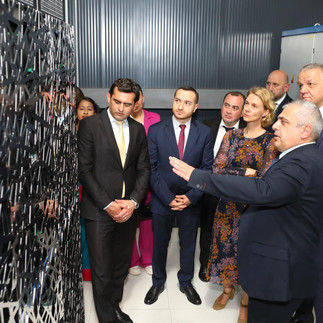


ARMENIAN NATIONAL SUPERCOMPUTING CENTER
ANSCC is pioneer high performance computing (HPC) and data management techniques in Armenia and the region through assistance, research and education by tackling scientific and societal challenges.
Manufacturer: Atos
Cores: 24,480 cores
Memory: 39 TB
Storage: 2.7 PB (Raw Capacity)
Interconnect: Infiniband FDR
Nodes: Bullx BL720 (2 x E5-2698V4, 64GB DDR4, 256GB SSD)
Peak performance: 861.7 TFlop/s
Supercomputing project
To address a wide range of societal, industrial and scientific challenges in Armenia, the Project established a National Supercomputing Center of Armenia to provide an ecosystem for all academic communities, industry and the public sector. The main objective of the Project is to increase the competitiveness of Armenian economy in high-tech sector by creating innovative solutions specialized in the fields of high-performance computing (HPC), cloud computing, big data, large scale data analytics and artificial intelligence, as well as by facilitating the skills development for preparation of qualified specialists.
The project consists of the following three main pillars:
To provide large scale computational and data resources and services enhancing the scientific excellence and innovation competences, to conduct new scientific research projects and to train professionals through capacity building activities;
To strengthen the engineering capacities to operate the newly deployed TFLOP supercomputer via providing cloud, machine learning, data analytics and other services;
In-depth user support and awareness raising to academia and industry across all disciplines via, various trainings, workshops and summer schools.

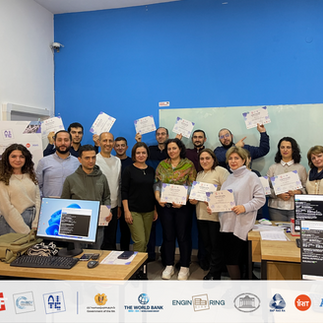
Training sessions: 19 Training sessions and workshops have been organized by the Armenian Indian Center of Excellence in ICT during 2023-2024.
Number of Applicants`709
Shortlisted` 411
Graduated` 297
List of Trainings
Cybersecurity
Scientific computing with Python
Data Analysis and Plotting in Python with Pandas
Scientific computing with Julia language
Foundations of Big Data: Exploring Architectures and Databases
Parallel Computing with MPI
Cloud Computing and virtualization technologies
Shell programming in Linux
Introduction to Molecular Dynamics in HPC
Introduction to the first principles modeling in HPC
Data Visualization with Python
Introduction to Big Data Analytics
Hands on training
"Network Administration: IP Addressing and Routing” ToT
Spring School Unlocking the power of HPC and utilizing computational resources
Participants number for 19th trainings were 411 and 297 from them graduate courses and received certificates
4 Workshops have been organized, participants number are 89
Introduction of Armenian National Supercomputing Center and Engineering city
The Present and Future of Supercomputing
Big Data Management in HPC Systems
The Present and Future of Supercomputing